A Mere Domestic Convenience: Parenting and Its Pitfalls
Love kids? Then clearly you’ve never been a stay-at-home dad. I have, and the whole weird and wonderful experience has taught me an important lesson: that when it comes to children, a little of them goes a long, long way.
Which is why, after four years in the saddle, I’m breaking out of the stable. Don’t get the wrong idea – as a (part-time) stay-at-home parent, I’m the beast here, not the rider. It’s just that I’m tired of doing the donkey work.
And my kids are great. Happy and healthy, bright-eyed and bushy-tailed, they’re all I hoped for and more. The only problem, of course, is that they’re children. Dependent, demanding and – most trying of all – distracting. I mean, how’s a bloke supposed to think?
By going back to work, that’s how. Before long, I’ll be a full-time employee again, having spent two days a week at home for the past five years. Sitting at my desk doing my mundane work, I’ll soon be able to daydream in peace – all through the week.
It’s sad, really, but true. And yet I’m not the only one who feels this way, you can be Shaw of that. George Bernard Shaw of that, in fact. Ever read his essay, ‘What Is Wrong With Our System of Education‘? You should. In it, GBS cuts close to the bone, his tongue only half in his cheek.
‘That children and adults cannot live together comfortably is a simple fact of nature,’ Shaw writes, instantly making me feel a little less guilt. Fortunately (for me), he carries on in much the same vein.
. . . if I have to be medical officer of health, wardrobe mistress, sanitary inspector, surgeon for minor operations, fountain of justice and general earthly providence for a houseful of children . . . I shall be so interrupted and molested and hindered and hampered in any business, profession, or adult interest, artistic, philosophic, or intellectual, which I may be naturally qualified to pursue, that I shall have to choose between being a mere domestic convenience and getting rid of my children somehow.
Well, I have chosen. Rather than ridding myself of my kids, though, I’ve decided to rid them of me – Monday to Friday, at least. Out I go and in comes that mere domestic convenience, my more-than-willing wife.
She loves kids, you see.
Majority Report: Coming of Age Online
‘Eighteen is an amazing number.’ That’s how I was going to start this, my eighteenth post. Couldn’t do it, though. For after reading the sentence eighteen times, I realised that, strictly speaking, ‘eighteen’ isn’t a number at all. It’s a word.
Tricky, huh?
And the trickiness soon trebled. Also unacceptable as an opener was ’18 is an amazing number’, my next go-to line, simply because no self-respecting writer (or even me) starts a sentence with a number – it’s just not the done thing. In fact, it’s a dumb thing.
That left me with the following phrase which, you’ll be pleased to know, I’ve deemed good enough to be going on with – even after multiple rereads and a repast. So, now I’ll begin again, properly this time…
It’s an amazing number, 18. It’s the only number, apart from zero, that equals twice the sum of its digits. (And what’s zero? Nothing!) It’s the numerical value, too, of the Hebrew word for ‘life’. (Turns out our days are numbered, after all.) And it’s the number of chapters in James Joyce’s Ulysses. (Who’d have known?)
More importantly, though, eighteen is the age at which, in many cultures, kids magically morph into adults. Yes, it’s the infamous ‘age of majority’, that time when weedy teens join the rest of us on our sacred mission: the trashing of self and society, all in the glorious pursuit of pleasure.
At a stroke, mere striplings are granted the right to vote for the wrong people; at a stroke, they’re allowed – nay, expected – to start harming themselves, instead of relying on their elders to do it for them. Suddenly, liquor is legal and so are the smokes.
Coming of age. It’s a time, too, for reflection – of reviewing the mistakes you’ve made, and of previewing those you’re about to make. And that, I’ve decided, is what I’m going to do in this, my eighteenth post.
Believe it or not, I’ve got things wrong, bloglistically speaking. My posts have been too hard to get a handle on, for a start – handles on a post? – as has my blog as a whole. At fault, I think, has been my ethos of ‘tough love’; my failure, that is, to kiss up to my readers. Keep it simple, stupid, I do not. For better or worse, I insist on being ‘artful’ in my approach.
Obscurity, here I come!
That said, I’m not going to alter my style much at all, since I think it has some personality and potential. I will, though, do a little window dressing: my titles will become more descriptive and the rest of my blog less distracting. I might even focus on fewer subjects… Small mercies, I know, but better than nowt.
What’s eighteen anyway? Just another number.
Blogging Bad: Seven Reasons Why Lists Suck
It’s something we’ve all heard a hundred times and which we accept without hesitation: readers love lists. From DIY pieces such as ‘Holy trinity: Spiritual perfection in three short steps’ to top-pick posts like ‘Best of the worst: Thirteen unlucky numbers to die for’, lists are hailed universally as the answer to online anonymity.
Simply set out your points on the screen like rungs in a ladder and you’ll soon find yourself climbing the stairway to stardom – so the story goes.
Guess what? It ain’t necessarily so. Lists suck, despite all the hype. Keen on dots and dashes? Don’t be. Morse code went out with the printing press. Hooked on bullets? Their impact can be deadening, so aim a little higher. Headed for headings? Think again: titles are liable to trip readers up.
And that’s just for starters. Here, then, are seven ripping reasons why you should wipe lists from your writing repertoire.
1. Lists are sneaky
Since when is anything in life as simple as one, two, three? Hardly ever, mostly never. And yet lists slyly suggest just this: that every little thing can be reduced to a series of points or pointers. Nobody ever wrote a novel or lost weight simply by following a series of steps, so do yourself a favour and stop treating readers like the idiots they probably are.
2. Lists aren’t sneaky enough
There’s sneaky and then there’s sneaky. Proper dinky-di personal essays, for example, can’t help making life more intelligible, if only because they speak a universal language: the rhetoric of experience rather than mere sensation. Sure, essays reduce reality, too, but they do so in ways that seem to magnify meaning. It’s called art, and it’s artful – unlike most lists.
3. Lists are easy
Do you really want to dash-off a list when you could send yourself half-crazy penning an essay instead? Fact is, no-one ever got writer’s block while writing out a shopping list or scribbling down a list of things to do. Doesn’t that tell you something? Yes, that lists are too damn glib for their own good, otherwise a literary sub-genre would have congealed around them long ago, as it did with the Personal Essay (hallowed be its name).
4. Lists aren’t easy enough
In other ways, though, lists are bloody hard. To number a list you have to be able to count, and writers aren’t renowned for their numerical nous. I mean, some scribblers claim to write 300 words a day, and yet, when the dross is discarded, the total usually amounts to no more than twenty-six. Go figure! To get a list right in Microsoft Word is also a drag, especially if Autocorrect keeps automatically getting things wrong. Grrr.
5. Lists are everywhere
This point is self-evident, surely, given that you’re staring at a list – this list – right now. And even if you’re not, you’re no doubt staring at a list somewhere else online, only you don’t know it. Well, you probably do know it, but what I mean is that you don’t know that I know it. Yikes! What’s Google, anyway, if not one big list.
6. Lists aren’t everywhere enough
So, okay, lists litter the internet. When it comes to the real world, though, they’re nowhere that counts. Ever come across any classic lists? Nope. Ever study lists at school? Nope. Where’s the great tradition of list-writing? Nope – totally missing, I mean. Forget kudos, too, because writing a list ain’t going to win you a literary prize or grant you the grudging respect of any envious authors. All you’ll get from writing a list is, well, a list. Say no more.
7. Six reasons are enough
Studies have shown that six reasons are sufficient. Full stop. Apparently, the human brain is incapable of marshalling more than one or two thoughts at a time – unless they involve food or sex, of course – so why burden and enrage your readers with unnecessary information. Most of them tune out during reason number seven, anyway – hello?
Clearly, lists suck. This one sure does.
If you’re itching to read more about writing and blogging, I suggest you look elsewhere. Too lazy to leave my blog? Why not try these thrilling posts: Novelists Write Novels, On Being a Back-to-Front Writer and Hanging on Every Word. Lots of words, some good enough to read.
Frightening to the Power of X: How I Saved Civilisation (Again)
Sometimes the deadliest things seem the most harmless. Take the whale shark. On the surface, this fat fish resembles a peace-loving kale-nibbling mammal; peer into its blowhole, though, and you’ll catch a gut-churning glimpse of the real thing: a malevolent predator bursting to bite you in two.
Frightening.
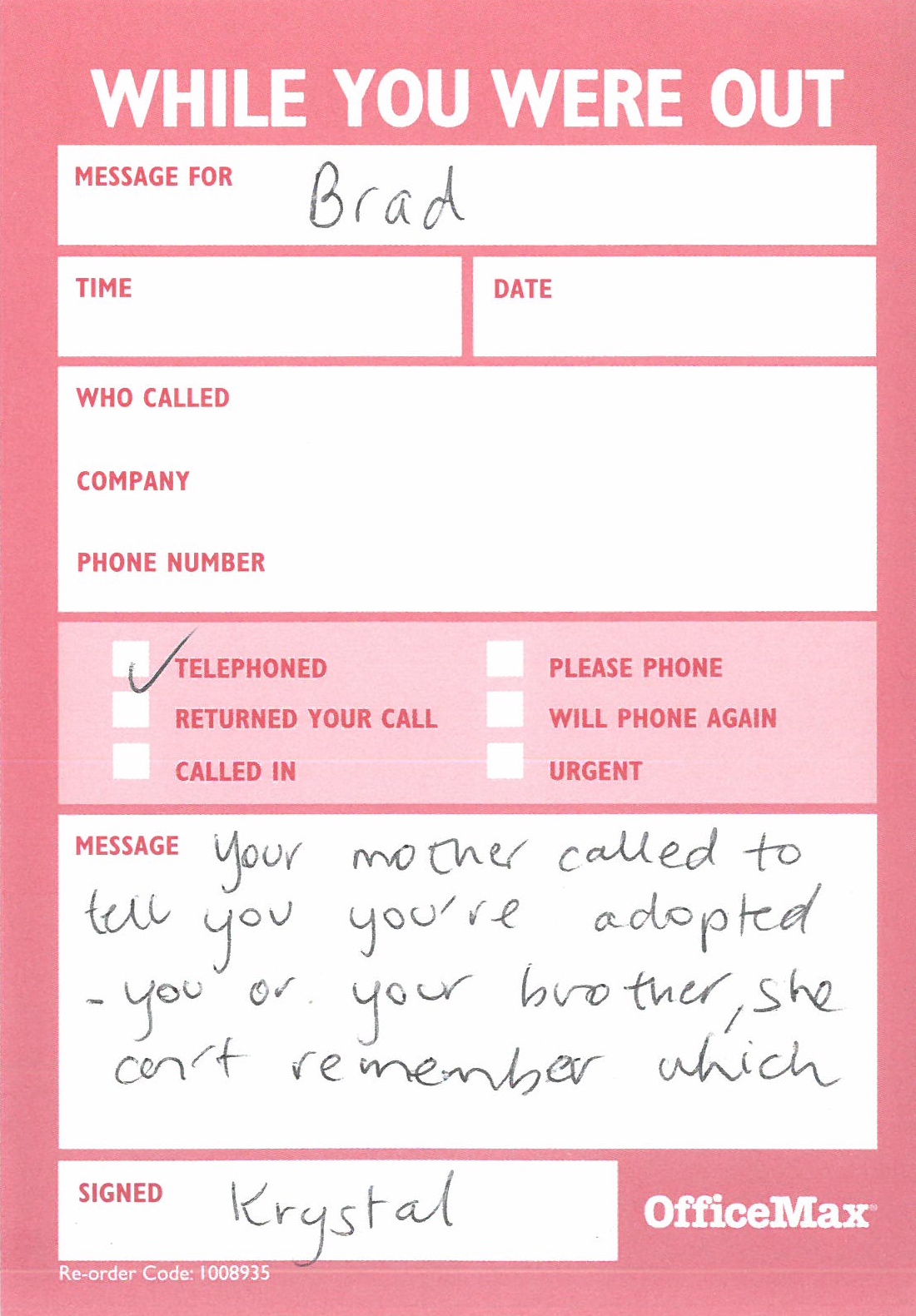
Then there are ‘innocent’ messages like the one I whisked away from a desk today. At first glance, this little note speaks of a simple adhesive slip-up and the chance misplacement of a mug. Sad but insignificant. And yet, when fully decoded, it tells of something infinitely more sinister – of a family ravaged by addiction and, egad, of a civilisation whose innards are being eaten out by moral corruption of the vilest kind.
Frightening plus 1.
To make matters worse, this message was left in the open, totally nude, a veritable spark itching to ignite the imaginations of passing public servants, one which would do them – and society – no end of harm.
Frightening to the power of X.
Luckily, I was on hand to whisk it away, and, as usual, I reproduce it here as a warning to the unwise. Now that’s how you take a message!

Shocked and want to know more? Try Mother Knows Best and Off the Couch.
As Thin as Thieves: From Sausages to Civil Society
What do sausages and civil society have in common? A lot, I reckon, if the following story is anything to go by. Set in a butcher’s shop, this telling tale has a cast of three: Mal, Muir and me…
It’s a Sunday morning, and I’m out shopping for food with my omnivorous offspring, Angus and Eliza. Having gathered groceries from the supermarket, we go hunting fresh meat, tiptoeing across town in the Magna-Carter. The trail ends, unsurprisingly, at the door of our pet butcher, Mal.
I park on the street where the kids can see into the shop. Handing them two super-sized apples, I utter those famous last words: ‘Won’t be long.’
Mal himself is behind the counter.
‘Now I know why I pay my staff extra on Sundays,’ he says, as I pass him a tray of lasagne ($11.95), two packs of dog’s mince ($19.60) and a carton of eggs ($5.20). ‘It’s bloody hard work.’
I glance around at the crush of customers and grin. ‘Looks like it,’ I reply, trying to remember what’s next on my unwritten list.
Mal pauses in the totting up, which buys me more time. ‘Usually I’m such a neat freak,’ he confesses, ‘but it’s been go go go all morning. I wouldn’t normally leave this tray of chops here – I’d have to put it straight back where it belongs. It’s just been that kind of day.’
As he fiddles with the register, I wave at my curious kids, who are watching me intently over their hot-air balloons. A fellow customer almost waves back, out of instinct. Almost.
‘Get you anything else?’
‘Bacon,’ I say smoothly, as if I’d known all along. ‘A pack of your smoked stuff [$4.90]. Oh, and about 300 grams of your ham [$5.25].’
As Mal weighs it out, I notice a sign behind the glass advertising a freebie: one peri-peri chicken burger per customer. An award-winning peri-peri chicken burger, at that.
‘Not happy being National Sausage King?’ I ask him, in jest. ‘You gotta be Burger Baron as well? Talk about greedy.’
He looks a little sheepish and slows down on the ham.
‘Just trying to stay on top,’ he says. ‘Actually, the awards were only the other week. Talk about nervous. There I was taking selfies from under the table and up on stage. Almost dropped my phone, not to mention the trophy. Very happy, though.’
‘Keep this up you’ll need a new shelf for your silverware,’ I joke, looking at the full one above his head.
‘Funny you should say that,’ he replies. ‘I’ve been thinking about making room on the wall over there…’
‘It must make marketing easier,’ I add, perceptively. ‘All these prizes.’
‘Well, that’s it. It’s so competitive these days.’
The only competition I can see is for first place in the queue at the counter. Short-sighted, that’s me.
‘Get you anything else?’
I ask for a dozen beef sausages.
‘Thick or thin,’ Mal wants to know.
And this is where Prof. Muir comes in – figuratively, of course, as befits his theoretical status. ‘Thin,’ the Prof. hisses. ‘Go with the thin.’
So I do. And while Mal is out the back securing the snags, Muir states his case.
‘You wanna live in a civil society? Of course you do. Well, here’s the thing: it’s not your relationships with friends and relatives that matter so much. Nope, it’s the interactions you have with your acquaintances that really count.’
‘Okay…’ I mumble, thinking back to the journal article in which I’d first encountered this idea.
The Prof. snorts, and charges on.
‘It’s not okay, you ninny, unless you work on the “thin trust” you share with others. By that I mean the relationships you have with virtual strangers. Forget the “thick” stuff – the bonds you form with those you know and love. They’ll tend to be civil anyway. Always go with the thin. Got it?’
‘I think so. Try to empathise with the people you meet, and society will be all the better for it.’
‘Something like that,’ Muir says, disappearing into thin air – yes, thin air – as Mal returns.
‘That the lot?’ he asks, weighing the sausages ($8.40).
I respond with my customary closing rejoinder. ‘Yeah, I’d better stop there.’
‘That comes to sixty-one,’ he says, bagging me my free peri-peri chicken burger while I’m fishing for the cash.
‘Thanks, Mal,’ I say, taking the bag from him. It’s the closest we come to shaking hands, our exchange having come to an end.
‘Enjoy,’ he says. ‘Now, who was next?’
Back in the car, the kids have given up on their apples. ‘That took a long time,’ Angus points out.
‘It did, didn’t it,’ I say, rather proudly.
I sit for a moment and ponder the thick and the thin. Thing is, I think I believe all that stuff. Why? Probably because, for me, ‘thick’ relationships have always been a bit thin on the ground. Connecting with strangers – that, I muse, is more my cup of tea. After all, it’s only when we face the unfamiliar that our moral mettle is truly tested.
Sixty-one dollars? I reach into the bag for my receipt and, closing my ears to the chorus of protests from behind, I do the sums.
They don’t add up.
What price a civil society? Oh, about six dollars.
Cheap at half the price, I tell myself as I drive away. Mal and me, we’re as thin as thieves, and I’m going to do my best to keep it that way, even if it leads to a miscalculation or two. Our future might just depend on it.
Halfway home, I remember my free peri-peri chicken burger, which puts the icing on the cake. I’m hungry too. Saving civilisation – or even simply shopping – sure gives a bloke an appetite.
Intermission (1): When Depression Isn’t the End of the Show
The last time this happened I managed to grind out five lines of verse.
When the curtain descends
the performance ends.
Strutting player becomes
shadowed puppet,
emptied of itself.
Sounds like the show’s over, doesn’t it? Not so. It’s merely intermission – as the rest of the poem was supposed to reveal.
That was a month or two ago. This time, though, I’ve got nothing, which is more normal. No ideas, no emotions, no energy; no patience, no confidence, no hope. Okay, I’ve got plenty of self-pity, but we all know lots of a negative doesn’t amount to much.
Depression’ll do that to you.
Churchill called it his ‘black dog’, yet the metaphor doesn’t work for me. Mild concussion – that’s how I think of my condition. Many of the symptoms are the same: confusion, sluggishness, irritability, difficulty concentrating, slowed reactions. And like concussion, depression passes.
I remember reading an essay about mental illness and writing. Its author tried to dispel the notion that the first is good for the second, that depression is a creative force. She argued that it ain’t good for anything, really, since it stops things happening.
That’s my experience, I’ve got to say. Usually, I can’t write a thing. Can’t even think a thing. Can read and listen, though, which means I try to drown my sorrows in novels and classical music during my ‘downtimes’. I used to, at least. I’ve got a job and a family now.
Having started this post with bad poetry, I’ll end it with something good. Here’s an excerpt from The Merchant of Venice which, somewhat perversely, makes me happy. Hope it does the same for you, especially if you’re feeling blue. Take it away, Antonio…
In sooth, I know not why I am so sad:
It wearies me; you say it wearies you;
But how I caught it, found it, or came by it,
What stuff ’tis made of, whereof it is born,
I am to learn;
And such a want-wit sadness makes of me,
That I have much ado to know myself.
Sounds like intermission is over.
Painting Over the Past: Does History Hinder or Help?
The past. We’re more used to seeing it on the walls of museums and ancient ruins than on the walls of our homes. And yet you’ll find it there too, if you scrape hard enough.
Ancient ruins? Yeah, like those of Pompeii, with all their candid graffiti. ‘I screwed the barmaid,’ scrawls one Roman. ‘O walls,’ writes another, ‘you have held up so much tedious graffiti that I am amazed that you have not already collapsed in ruin.’ And then there’s ‘Nothing ever happens in this shitty little city,’ which, sadly, I had to make up.
Sorry!
Anyway, that’s what this budding novelist has been doing for the past week: scraping old paint off the walls of his house. Stripping away the past, as it were, layer by colourful layer. Brown, blue, purple, orange – it’s as if I’ve been living under a rainbow.
A toxic rainbow, of course, which explains why my family has decamped for the duration, and why for a week my noble visage has been half-hidden by a mask. Weep, ladies, weep! It’s the lead, you see, it’s dleadly.
In ancient Rome, people put this highly malleable metal in water pipes; in the nineteenth century, they put it in wine (to sweeten it); in the twentieth century, they put it in paint. That’s progress for you. Now paint comes free from artificial sweeteners, which makes it harder to swallow but supposedly much safer. Goody.
So there I am, perched on a stepladder, laying bare the history of my house with a hand-scraper, stroke by wearisome stroke, as if I’m turning the pages of a book. And I’m thinking, why does old stuff always seem so dangerous; I mean, that’s what Freud was essentially on about, right? Buried stuff coming back to bite us.
That’s when I get to the woody flesh beneath the sickly skin. Pure, unadulterated timber that once formed part of a wholesome, harmless tree, one that would never drop a branch on your head or try to trip you up with a rearing root. O, I cry (metaphorically), why did we ever exchange nature for culture? Then I put my blade through a rotten board and immediately I know. Like the present, the past is as much enemy as ally.
And, yes, that’s pretty profound.
But wait – there’s more. A lot more, alas, because this post was supposed to save me work by featuring something I wrote in the past, about the past. Something from another blog I once kept. Something called ‘Little Chicago’.
What’s in a hat? Memories, of course.
Over Easter, Queen Jane and I were whisked away by Dennis Potter’s redolent rendering of the Mayor of Casterbridge to Upper Wessex, where we followed the fall of a man undone, like Achilles, by unassuageable anger. Afterwards, we made our own descent: into the heart of our local hamlet, where Jane browsed wares while I sat reading in the sun.
‘There’s a bluebeardy look about ’en,’ Nance Mockridge said, of the aforementioned Mayor. ‘Stuff – he’s well enough!’ replied Christopher Coney. ‘Some folk want their luck buttered.’
Before long I was approached by a nuggety old bloke, who drew me out of Casterbridge (for, having finished the screenplay, I had started the book) and into conversation. Like townsfolk from Hardy’s tale, we parleyed in High Street.
My companion spoke, in thick English, of various things: of his heart’s fatal flaw and his decision to stay the surgeon’s hand; of his native country, Poland, and his arrival in this, his chosen land; and then, remarkably, of my own adopted home, the suburb of Springfield. It, he said, had been a Polish place, like another, in America, only smaller. Little Chicago, they called it.
Finally, he said he liked my hat.
I own two hats. One came to me from a market stall; the other, from my grandfather. As usual, I was wearing the first, for, unlike the second, which is heavy with age, it is young and lightweight.
My companion added to its store of memories. More importantly, though, he wore his own dusky thin-brimmed cap as if it were more ballast than burden. History, he showed, has a steadying hand.
So, you see, it’s not all bad.
I don’t care. The rain having stopped, I’m now going to go and do my bit to poison and preserve humankind. I’m going to go and paint over the past.
Novelists Write Novels: The Pencil Drops
Some writers are slow, some are fast. Me, I’m a sluggard. Not at putting words on paper, mind you, but at understanding what it takes to be a writer. On the weekend, though, the pencil dropped, and I finally got it. To be novelist, I realised, one has to at least finish a novel.
Kinda makes sense, doesn’t it?
This brutal truth bit me while I was attending a children’s literature festival on a small southern island adjacent to my own. I’d booked a session with a guest editor – an Associate Publisher at Penguin, no less – who praised the sample of the children’s novel I’d sent her without offering me a contract for it on the spot.
The cheek of the woman!
Then there were the visiting authors, who seemed pretty happy with the whole affair, despite the inclement weather. Writers are renowned for being highly perceptive beasts, and yet not one of those smug scribblers saw me for what I am: a fellow author. And just because I haven’t published a book! Talk about petty. Yes, I felt snubbed, and, yes, I’m embarrassed to admit it.
Ah, the truth hurts.
In some areas of life being a dreamer helps. Clearly, this isn’t one of them. Because, believe it or not, part of me had assumed writing was going to be easy: that someone – this editor, for starters – would one day recognise my Obvious Talent and, with a wave of her magic pen, make me a novelist, just like that. Job done. Forget chapters four to forty – they’d somehow take care of themselves.
Wishful thinking, it’s called.
Okay, okay – I’m an idiot. But at least now I’m an all-shook-up idiot, one who is finally coming to terms with the idea that writing is, as a wise guy once said, one per cent inspiration, ninety-nine per cent perspiration.
Not that I’m averse to hard work. A year or two ago, I slaved away to finish my Arts degree, sometimes writing close to ten thousand words a week, and pretty good ones at that. As a young tyro, too, I wrote for days on end, churning out long first chapters that never seemed to grow into novels. Bloody things.
To this day, an anthology of these fragments – entitled False Starts – remains unfinished.
No, it wasn’t laziness that misled me. More like distorted self-confidence, I reckon. A superiority complex that convinced me I was entitled to success, interspersed with the opposite – a sense of inferiority – which told me I didn’t deserve it, no matter how hard I worked.
Whatever. I now accept that if I want my Associate Publisher to make me an author, I’m going to have to do what, oddly enough, I really want to do: churn out words until the job is done. Only thus will I win my literary spurs. Novelists write novels, after all.
Feathers and Fur (Part 2): The Climactic Conclusion
There are characters and then there are, well, characters. Some are new and unknown to us, like Anthony Burgess’ dyspeptic poet, Enderby, or the merciless Major Woolley of Goshawk Squadron.
Others, though, seem all too familiar. Take that fetishistic fashionista, Goldie de Groot, and model turned marketer, Chad Wilcox. Don’t you just feel like you know them already?
And so you should! These two unforgettable folk star in the erotic humdinger, ‘Feathers and Fur’, the first instalment of which I posted on this very blog only weeks ago. Slipped your memory? Well, here it is again – go back and bone up on it, please.
Thing is, faithful followers, I reckon I’ve kept all seventeen of you in suspense long enough. Clearly you’re dying to know more about Golden Girl and the Chadster. I mean, what is she hiding under that boa? And how is his piece coming along?
Switch off the artificial respirator – relief has arrived. For here, impure and adulterated, is the climax of that ‘twisted tale of doctored strangelove’. First, though, a warning: this excerpt contains cats, so if our feline friends make you itch then you’d better don some protection pronto. Allergies are nothing to sneeze at, you know.
‘Yes,’ Goldie said. ‘I’m into feathers.’
I looked up and saw a coppery feather boa shimmering in the doorway. Behind it was a body, mostly naked. Butt-naked, as far as I could tell.
‘You’re in feathers,’ I pointed out, somewhat pedantically. Then I raised my eyebrows, adding, ‘And now you’re not.’
Goldie had slipped the boa over her head and was holding it before her, somehow still managing to obscure her best bits. As she stroked the plumage, I couldn’t help thinking of her puss. Hot and loose.
I shifted in my seat and peered at the notes I hadn’t made in my notebook.
All the while, Goldie kept stroking, stroking, watching me with a crooked little smile on her lips. And what good lips they were. Not too fat, not too thin. Just right.
‘Trouble is,’ I said, clearing my throat, ‘it’s usually the male birds that have the bright plumage.’
Her smile widened. ‘I like a man who knows his ornithology.’
‘Don’t get me wrong,’ I said. ‘I’m no twitcher.’
‘I’ll be the judge of that,’ Goldie said, before padding across the floor in her bare feet.
And what good feet they were. Not too big, not too small. Just right. And they led to good legs. Legs to live by.
‘Up,’ she said, with a tug at my collar. ‘And around.’
I stood with my back to her, staring unseeingly at the prints on the wall above her desk. My signature look, it seemed, had returned.
For a while I lost track of the boa. Goldie’s hands were busy with my buttons, so I suppose it had found its way back around her neck. Before long, though, the fluffy fiend made its presence felt; slowly, softly, it swept across my various nooks and crannies; then, with a murmur, it surmounted a rise, where it wavered for a while, trembling back and forth. Back and forth.
Back. And forth.
With things coming to a head, I decided to turn the tables.
‘By the way,’ Goldie murmured, as I took the boa from her. ‘I’ve never been to Brazil.’
‘Very wise,’ I replied, pivoting her until I had her back. ‘It’s overrated.’
Threading the brown boa between those taut creamy thighs, I began to run it back and forth.
‘Bingo,’ Goldie whispered. ‘Feathers and fur.’
Back and forth.
‘Surely fake emu feathers should be more moisture-proof,’ I said, after a minute or two.
‘Fake ostrich,’ Goldie replied, a little breathlessly.
Back. And forth.
Then, rounding on me, Goldie tugged the boa from my grasp.
‘Plumage is important,’ she said, ‘up to a point. But a bird has to know when to bury its head. In the sand.’
Balling up the boa, she tossed it across the room, where it fluttered to the floor like a plummeting pigeon.
‘Fake sand?’ I asked.
‘Quick sand,’ she said, and steered me towards the desk.
By the time the interview was over, my coffee was well and truly cold. Which, for some strange reason, made it just right. Best coffee I ever had.
‘What about the article?’ I said, putting away my empty notebook.
Goldie tucked the boa into the pocket of my jeans.
‘Oh, I think you’ve got enough to go on,’ she said, giving it a friendly pat. ‘If you don’t, use your imagination. That shouldn’t be hard, Mr Faraway Man.’
I checked my watch as I crossed the shop floor. Not too long, after all, and not a second too short. Just right. I grinned. With that sort of passion and professionalism, how could either of us fail?
Blowing a last kiss to the mannequins, I stepped out on to the street.
True story!
Mother Knows Best: How I Saved Civilisation (Again)
It’s a new year but has anything changed? Of course not. The fate of civilisation still hangs in the balance, thanks to the pig-headed ham-fistedness of bureaucats and dogs everywhere.
Why, no sooner had I returned to my post at the elbow of power (or thereabouts) than I chanced upon the following scrap of paper, left smouldering on a desk by some incautious ignoramus. Fortunately I was on hand to whisk it away, thereby protecting the privacy – not to mention the welfare – of all concerned.
That’s how you take a message!
- ← Previous
- 1
- …
- 7
- 8
- 9
- Next →
 timm in type